Exness Spread: Spreads by Account Type, Pips (2026)
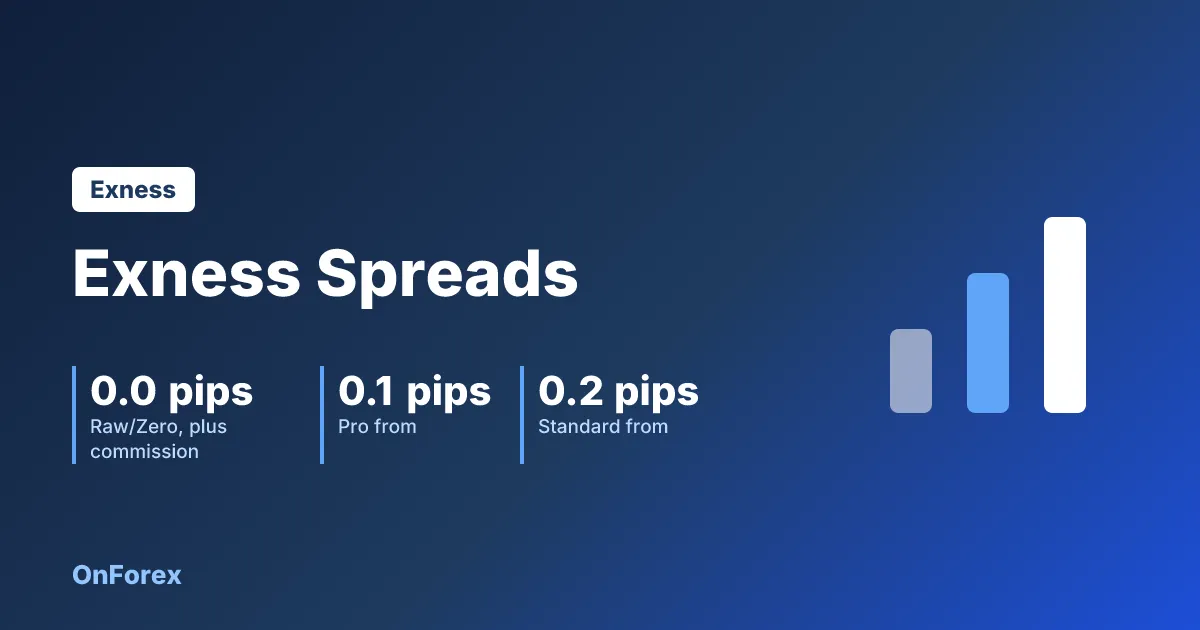
Exness spread by account type: from 0.3 pips on Standard Cent, 0.2 Standard, 0.1 Pro, 0.0 on Raw Spread and Zero plus commission. Spreads can widen on news.
This site contains affiliate links. We may earn a commission if you sign up through our links. How we research
The Exness spread depends on the account type: Exness spreads start from 0.2 pips on Standard, 0.3 pips on Standard Cent, 0.1 pips on Pro, and 0.0 pips on Raw Spread and Zero. Raw Spread and Zero add a commission per lot. These are minimums, not fixed prices: most spreads float and change with market conditions, so check the live spread in your platform or the contract specifications before you trade. Spreads can widen around news, at market open and close and in volatile conditions.
Disclosure: OnForex earns a referral commission if you open an Exness account through our links.
| Account type | Spread | Commission | Minimum initial deposit |
|---|---|---|---|
| Standard Cent | From 0.3 pips | None | No fixed minimum; depends on payment method |
| Standard | From 0.2 pips | None | No fixed minimum; depends on payment method |
| Pro | From 0.1 pips | None | From 200 USD, region based |
| Raw Spread | From 0.0 pips | Up to 3.50 USD per lot per side | From 200 USD, region based |
| Zero | From 0.0 pips | From 0.05 USD per lot per side, by instrument | From 200 USD, region based |
Sources: Trading account types, What trading account type should I use?, Raw Spread account, Zero account, Exness Help Center, checked November 14, 2026 against the account types table (last updated by Exness November 12, 2026).
- Standard Cent
- From 0.3 pips
- Standard
- From 0.2 pips
- Pro
- From 0.1 pips
- Raw Spread
- From 0.0 pips
- Zero
- From 0.0 pips
Longer bar = higher minimum spread. These are minimums, not fixed spreads, and Raw Spread and Zero also charge a commission per lot, so spread alone does not show total cost. Source: Exness Help Center, checked October 23, 2026
This page covers spreads. For commission, swaps and payment costs in one place, see Exness fees. For the full comparison of the five accounts (minimum deposit, execution, lot size, stop out), see Exness account types.
Exness spread list by symbol group and account type
Exness publishes a minimum spread per account type, not one spread per symbol. What differs by symbol group is the contract size, which accounts offer it and, on Raw Spread and Zero, the commission. This table collects the Help Center contract specifications.
| Symbol group | Examples | Offered on | Contract size | Commission per lot per side (Raw Spread / Zero) |
|---|---|---|---|---|
| Forex majors | EURUSD, GBPUSD, USDJPY, NZDUSD | All five account types | 100,000 units | From 3.50 USD / from 0.05 USD |
| Forex minors | EURGBP, EURNZD, AUDCAD | All five (Standard Cent has a selected list) | 100,000 units | Same as majors |
| Forex exotics | USDZAR, USDMXN, EURPLN | Standard, Pro, Raw Spread, Zero | 100,000 units | Same forex range |
| Gold | XAUUSD | All five account types | 100 troy ounces | 3.50 USD / 5.50 USD |
| Silver | XAGUSD | All five account types (Standard Cent as XAGUSDc) | 5,000 troy ounces | 3.50 USD / 50 USD |
| Natural gas | XNGUSD | Standard, Pro, Raw Spread, Zero | 10,000 MMBtu | 3.50 USD / 35 USD |
| Crypto CFDs | BTCUSD, ETHUSD | Standard, Pro, Raw Spread, Zero (Standard Cent: BTCUSDc, ETHUSDc on MT5) | BTCUSD 1 BTC, ETHUSD 1 ETH | BTCUSD 2.00 USD / 4.375 USD; ETHUSD 0.25 USD / 0.50 USD |
| Indices | US30, AUS200 | Standard, Pro, Raw Spread, Zero (Standard Cent: US30, US500, USTEC on MT5/Exness platforms) | 1 | US30 0.3125 USD / 0.625 USD; AUS200 0.375 USD / 0.75 USD |
| Stocks | AMZN, TSLA and other US stocks | Standard, Pro, Raw Spread, Zero (not Standard Cent) | 100 shares | Zero from 0.15 USD |
Sources: Exness Help Center contract specifications for Forex, Commodities, Cryptocurrencies, Indices and Stocks, checked October 31, 2026. Commission values change; the contract specifications in your Personal Area are the current source. Exness does not publish a fixed average spread for these symbols, so we do not quote one.
Stable-spread instruments. Exness lists EURUSD, XAUUSD, GBPUSD, USDJPY, GBPJPY, USDCAD, AUDUSD, USDCHF, EURJPY and EURGBP as instruments with stable spreads nearly 90% of the time, excluding periods of market volatility (About spread, checked October 31, 2026). Spreads can vary and widen with market volatility, news and market open/close.
Main instruments at a glance
| Instrument | Contract size | On Exness's stable-spread list | Raw Spread commission | Zero commission |
|---|---|---|---|---|
| EURUSD | 100,000 units | Yes | From 3.50 USD per lot per side (forex) | From 0.05 USD per lot per side (forex) |
| XAUUSD (gold) | 100 troy ounces | Yes | 3.50 USD per lot per side | 5.50 USD per lot per side |
Check live Exness spreads
Spreads change with the market. See the current contract specifications for each account type on Exness.
Continue to ExnessForex and CFD trading involves significant risk. You may lose your invested capital.
How Exness Spreads Work
Spread is the gap between an instrument's bid and ask price. Exness's own example: a bid of 1.11113 and an ask of 1.11125 give a spread of 0.00012, or 1.2 pips. Exness offers two kinds of spread (About spread, checked November 14, 2026):
- Dynamic (floating) spread changes constantly with market volatility and can be wider or narrower than average.
- Stable spread is calculated from a weighted average over a set timeframe, so it stays more predictable. Exness says these instruments offer stable spreads nearly 90% of the time, outside periods of market volatility: EURUSD, XAUUSD, GBPUSD, USDJPY, GBPJPY, USDCAD, AUDUSD, USDCHF, EURJPY, EURGBP. Spreads can vary and widen with market volatility, news and market open/close.
Exness names the main reasons spreads widen: market volatility, news releases, unexpected economic events, and market open or close. Majors usually have narrower spreads than exotics.
Zero account spreads
The Zero account has zero spread on the top 30 instruments for 95% of the day, and for other instruments 50% of the day, depending on market volatility. Spreads float during key periods such as economic news and rollovers, and can rise above 0 on the top 30 instruments during high volatility (Zero account, checked October 23, 2026).
Exness spread on the Standard account during news
The "from 0.2 pips" figure for the Standard account is a minimum, not a promise for every moment. Exness lists news releases, unexpected economic events, market volatility and market open or close as the main factors that widen spreads, and it recommends watching its Economic calendar to anticipate widened spreads (About spread, checked November 14, 2026). It does not publish a figure for how much a Standard spread widens, so we do not give one.
What this means in practice:
- Standard has no commission, so a wider spread is the whole extra cost of a trade. On a Raw Spread or Zero account the spread widens too, and the commission stays on top.
- Stable-spread pairs can still widen. Exness says its stable-spread instruments are stable nearly 90% of the time, excluding periods of market volatility, which is when news hits.
- Check before you trade. Look at the Spread column in Market Watch (MT4/MT5) or Exness Terminal a few minutes before a scheduled release and compare it with a quiet hour.
Spreads can vary and widen with market volatility, news and market open/close, and orders can fill at a different price from the one shown.
Exness spread on gold (XAUUSD)
Gold is quoted as XAUUSD with a 100 troy ounce contract. Exness lists it among the instruments with stable spreads nearly 90% of the time outside volatile periods, and says spreads widen around news and market open or close. Spreads can vary and widen with market volatility, news and market open/close. Gold is available on Standard, Standard Cent, Pro, Raw Spread and Zero accounts (XAUUSD247, the 7-day version, is not offered on Standard Cent). On Raw Spread the commission is 3.50 USD per lot per side, which is 7 USD for opening and closing one lot; on Zero it is 5.50 USD per side, or 11 USD per lot round trip. Add the live spread from your platform to get the full cost. For a broader comparison of brokers for gold, see best forex brokers for gold trading.
Exness spread on EURUSD
EURUSD is a major pair with a 100,000-unit contract and also sits on the stable-spread list. On commission accounts the forex commission starts at 3.50 USD per lot per side on Raw Spread and 0.05 USD per lot per side on Zero (checked October 27, 2026), and the exact value for EURUSD is shown in the contract specification in your Personal Area. On Standard, Standard Cent and Pro there is no commission, so the spread is the main cost. One pip on a standard lot is worth about 10 USD on a USD account.
Commission on Raw Spread and Zero
Only Raw Spread and Zero accounts charge a trading commission. It varies by instrument, is based on volume in both directions (open and close), and is charged in full when the order opens (Are trading accounts charged a commission fee?, checked October 23, 2026).
Examples from the Exness contract specifications (per lot, per side; checked October 23, 2026):
| Instrument | Raw Spread | Zero |
|---|---|---|
| Forex pairs | From 3.50 USD | From 0.05 USD |
| XAUUSD (gold) | 3.50 USD | 5.50 USD |
| XAGUSD (silver) | 3.50 USD | 50 USD |
Sources: Forex and Commodities specifications, Exness Help Center. Values for other instruments are in the contract specifications in your Personal Area.
- XAUUSD – Raw Spread
- 3.50 USD
- XAUUSD – Zero
- 5.50 USD
- XAGUSD – Raw Spread
- 3.50 USD
- XAGUSD – Zero
- 50 USD
Longer bar = higher commission. Values for other instruments are in the contract specifications in your Personal Area. Source: Exness Help Center, checked October 23, 2026
Why We Do Not List Average Spreads per Pair
Spreads on most instruments float, and the same pair can cost a different amount in the London session, at the daily rollover, or during a news release. A single "typical" number per pair would go out of date quickly and could mislead you. Instead, use the live sources below. For a deeper look at the commission accounts, see Exness Raw Spread and Exness Zero account.
How to Check Live Exness Spreads
Exness shows spreads differently depending on where you look (Why is spread different between the website and MetaTrader?, checked October 23, 2026):
| Where | What it shows | Unit |
|---|---|---|
| Exness website | Average spread of the previous trading day | Pips |
| Exness Terminal | Current spread | Pips (quote currency for crypto, energies, indices, stocks) |
| Exness Trade app | Current spread | Pips |
| MT4 / MT5 | Current spread | Points (2 pips = 20 points) |
In MT4: right-click the Market Watch window and select Spread. In MT5: right-click the Market Watch window, choose Columns, then Spread. In Exness Terminal: under Instruments, click the 3-dot icon and turn on Spread.
Steps from About spread, checked October 23, 2026.
How to Compare Total Cost
Spread is only part of the cost. To compare accounts for your own trading, add the parts together:
- Standard, Standard Cent, Pro: cost = spread in pips × pip value × lots
- Raw Spread, Zero: cost = (spread in pips × pip value × lots) + (commission per side × 2 × lots)
On EURUSD with a USD account, one pip on one standard lot (100,000 units) is worth 10 USD. Use the live spread you see in your platform, not a number from an article. Overnight swap can add to the cost if you hold positions past rollover; see Exness fees.
Is Exness good for trading EURNZD? How to read the spread on a cross pair
There is no single answer to "is Exness good for trading EURNZD" (or NZDUSD), and Exness does not publish a fixed spread for any pair. EURNZD is a cross pair (it does not include the US dollar), so its spread is usually read in pips against the account minimums above. What you can check is the cost of the pair on the account you would use. Work through these steps:
- Find the pair's group. NZDUSD is a forex major and EURNZD is a minor. Both use a 100,000-unit contract and are listed in the forex specifications for all five account types (the Standard Cent versions are NZDUSDc and EURNZDc). Exness says majors are traded in large volumes and usually have narrow spreads, while exotics usually have wide ones; check where a minor like EURNZD sits on your own platform (About spread).
- Open a demo account and watch the live spread. Add the pair to Market Watch and note the spread in the London and New York sessions, at rollover and around news. A demo shows how the pair behaves, though live conditions can differ.
- Add the commission if you use Raw Spread or Zero. The commission for the pair is in your Personal Area's contract specifications. See the cost formula below.
- Compare with your trade size. The same spread matters more for a scalper placing many trades a day than for someone holding for days. Swap matters for the second group; see Exness fees.
This is a way to judge cost, not a statement that any pair is cheap or profitable on Exness. Spreads can vary and widen with market volatility, news and market open/close.
Compare Exness account types
See which account type matches the spreads and commission you want to pay, and test it first on a demo. Forex and CFD trading carries a high risk of loss.
Continue to ExnessForex and CFD trading involves significant risk. You may lose your invested capital.
Frequently Asked Questions
What is the minimum spread on Exness?
From 0.0 pips on Raw Spread and Zero accounts, which charge a commission instead. Commission-free accounts start from 0.1 pips (Pro), 0.2 pips (Standard) and 0.3 pips (Standard Cent). Source: Exness Help Center, checked October 23, 2026.
Are Exness spreads fixed?
No. Most spreads are dynamic. Some major instruments have stable spreads nearly 90% of the time outside volatile periods, but they can still widen, for example around news. Spreads can vary and widen with market volatility, news and market open/close.
Why is the spread in MT4/MT5 ten times bigger than on the website?
MT4/MT5 show spread in points, while the website shows pips. 2 pips equals 20 points. The website also shows the previous day's average, not the current spread.
Do Exness spreads widen during news?
Yes. Exness lists news releases and market volatility among the main factors that widen spreads. Zero account spreads also float during news and rollovers.
What are the Exness account types and their spreads?
Standard Cent from 0.3 pips, Standard from 0.2 pips and Pro from 0.1 pips, all without commission, and Raw Spread and Zero from 0.0 pips with a commission per lot. Raw Spread and Zero need a higher first deposit. See the account table at the top, or Exness account types. Source: Trading account types, checked October 31, 2026.
Is Exness good for trading EURNZD or NZDUSD?
Exness offers both on all account types. Whether it suits you depends on the live spread and commission you see for the pair on your account, which is shown in your platform and contract specifications. Use the checklist above on a demo account first.
Does Exness have ECN accounts?
No. The Help Center says Exness does not provide ECN accounts; Raw Spread and Zero are the commission-based account types (What trading account type should I use?, checked October 31, 2026).
Where can I see the spread for a specific instrument?
In the contract specifications in your Personal Area, in the Market Watch window of MT4/MT5, or in the instrument list in Exness Terminal.
Further Reading
- Exness Fees 2026: Commission, Spreads, Swap and Payment Costs
- Exness Account Types Compared: Standard, Cent, Pro, Raw, Zero
- Exness Raw Spread Account: Commission, Spreads and Minimum Deposit
- Exness Zero Spread Account: Minimum Deposit and Commission
- Exness Demo Account: How to Open, Log In and Reset the Balance
- Exness Symbols List and Trading Instruments
Spreads are variable and change with market conditions. The figures on this page are minimums published by Exness, not guaranteed spreads; check current values in your trading platform. Trading forex and CFDs involves significant risk of loss.
Related Articles
Exness Account Types: Minimum Deposit, Spread, Commission
Exness account types compared: Standard, Standard Cent, Pro, Raw Spread and Zero. Minimum first deposit, spread and commission per account, checked Nov 15, 2026.
Exness Raw Spread Account: Spread, Commission, Min Deposit (2026)
Exness Raw Spread account: spread from 0.0 pips, commission up to 3.50 USD per lot per side, first deposit from 200 USD. Is Exness a good fit? Cost example.
Exness Zero Spread Account: Minimum Deposit and Commission
Exness zero spread account minimum deposit: from 200 USD, set by region. Plus the commission from 0.05 USD per lot per side, 0.0 spread hours and a cost example.
JustForex Raw Spread Minimum Deposit vs Exness (2026)
JustForex (now JustMarkets) Raw Spread minimum deposit is USD 200. Compare it with Exness Raw Spread: commission, spreads and account types. Checked Nov 21, 2026.
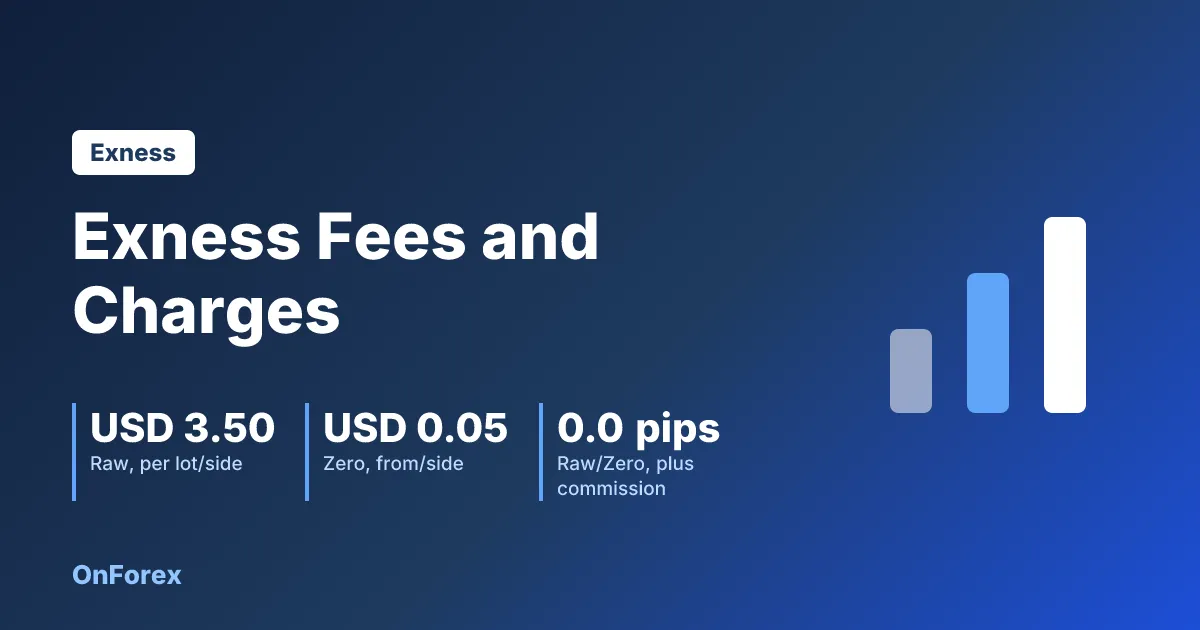
Exness Fees and Charges: Spread, Commission, Swap, Admin
Exness fees and charges in one table: spread, commission on Raw Spread and Zero only, swap, overnight admin fee, deposit and withdrawal fees. Checked Nov 15, 2026.
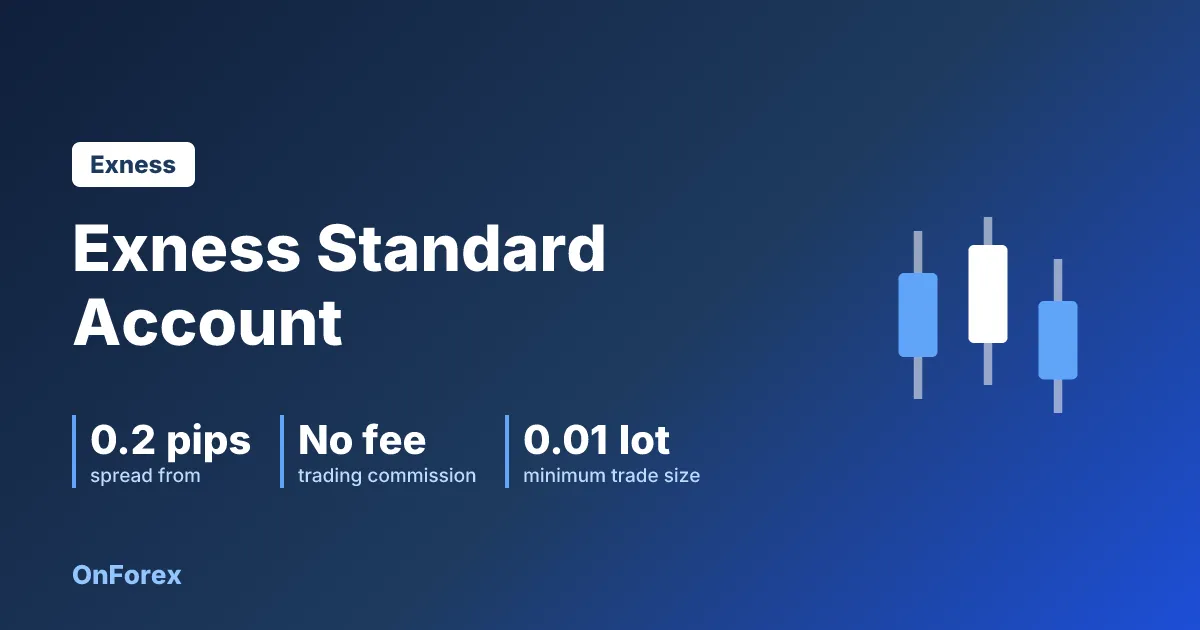
Exness Standard Account: Minimum Deposit, Spread, Fees
Exness Standard account: spread from 0.2 pips, no commission, market execution, 0.01 lot minimum, -m symbols. Deposit rules and how it differs from Cent, Pro and Zero.