Exness Indices: US30, USTEC (NAS100), US500 Specs
Exness indices list: US30, USTEC (Nasdaq-100), US500, DE30, UK100, JP225. Contract size, minimum lot, margin, swap, dividends and a checked margin example.
This site contains affiliate links. We may earn a commission if you sign up through our links. How we research
Exness offers 10 index CFDs: US30, USTEC, US500, DE30, UK100, FR40, STOXX50, JP225, HK50 and AUS200. On Exness the Dow Jones is US30, the Nasdaq-100 is USTEC (the symbol most traders search as NAS100 or US100) and the S&P 500 is US500. Each index has its own contract size, minimum lot, margin rule and commission on the Raw Spread and Zero accounts, and the Standard and Pro accounts charge no trading commission. Swap is tripled on Fridays, and dividend adjustments are applied to the balance. All values below come from the Exness Help Center and can change.
Disclosure: OnForex earns a referral commission if you open an Exness account through our links.
Check Exness indices conditions
See which index symbols, platforms and account types are offered in your region. Forex and CFD trading carries a high risk of loss.
Continue to ExnessForex and CFD trading involves significant risk. You may lose your invested capital.
Exness indices list: symbols and specifications
| Symbol | Index | Contract size | Pip size | Minimum lot | Fixed margin |
|---|---|---|---|---|---|
| US30 | Dow Jones (30 large US companies) | 1 (US30_x10: 10) | 1 | 0.05 (US30_x10: 0.01) | Not listed; see margin section |
| USTEC | Nasdaq-100 | 1 (USTEC_x100: 100) | 0.1 | 0.05 (USTEC_x100: 0.01) | Not listed; see margin section |
| US500 | S&P 500 | 1 (US500_x100: 100) | 0.1 | 0.14 (US500_x100: 0.03) | Not listed; see margin section |
| DE30 | DAX (30 German companies) | 1 | 1 | 0.07 | 0.5% (1:200) |
| UK100 | FTSE 100 | 1 | 0.1 | 0.05 | 0.5% (1:200) |
| FR40 | CAC 40 | 1 | 0.1 | 0.05 | 0.5% (1:200) |
| STOXX50 | Euro Stoxx 50 | 1 | 0.1 | 0.03 | 0.5% (1:200) |
| JP225 | Nikkei 225 | 1 | 1 | 3 | Not listed; see margin section |
| HK50 | Hong Kong 50 | 1 | 1 | 0.07 | 0.5% (1:200) |
| AUS200 | ASX 200 | 1 | 0.1 | 0.06 | 0.5% (1:200) |
Source: Indices (updated 13 Nov 2026), Exness Help Center, checked November 20, 2026. Indices trade on Exness Terminal, MT4 and MT5 on Standard, Pro, Raw Spread and Zero accounts. Execution is market execution on Standard, Raw Spread and Zero, and instant execution on Pro. On Standard MT4, indices are available only in 14 account currencies (AED, AUD, CNY, EGP, EUR, GBP, IDR, INR, KWD, MYR, THB, USD, VND, ZAR).
Maximum order size and commission
| Symbol | Maximum lots, day | Maximum lots, night | Raw Spread commission per lot per side | Zero commission per lot per side |
|---|---|---|---|---|
| US30 | 300 (MT4) / 500 (MT5); US30_x10: 20 | 100 | 0.3125 USD | 0.625 USD |
| USTEC | 300 (MT4) / 500 (MT5); USTEC_x100: 20 | 200 (MT5) | 0.3125 USD | 0.625 USD |
| US500 | 300 (MT4) / 1,000 (MT5); US500_x100: 20 | 300 (MT5) | 0.125 USD | 0.25 USD |
| DE30 | 300 | 100 | 0.3125 USD | 0.625 USD |
| UK100 | 300 | 120 | 0.375 USD | 0.75 USD |
| FR40 | 300 | 100 | 0.3125 USD | 0.625 USD |
| STOXX50 | 1,000 | 80 | 0.3125 USD | 0.625 USD |
| JP225 | 300 (MT4) / 5,000 (MT5) | 1,000 (MT5) | 0.02 USD | 0.02 USD |
| HK50 | 300 (MT4) / 500 (MT5) | 160 | 0.375 USD | 0.625 USD |
| AUS200 | 300 | 100 | 0.375 USD | 0.75 USD |
Same source and date. Day and night are the time bands used in the Exness specification; the exact hours are on the instrument page. Standard and Pro have no trading commission; their cost is the spread, which floats and can widen with volatility, news and market open/close.
Exness US30: Dow Jones
US30 is Exness's symbol for the Dow Jones index. Exness describes it as the value of 30 large, publicly owned US companies. The contract size is 1, so 1 lot is one unit of the index price: at an index level of 40,000, one lot is 40,000 USD of notional value. The minimum is 0.05 lot (0.01 lot on the amplified US30_x10, which has a contract size of 10). The pip size is 1 point. Exness lists US30 on a Standard Cent account too, but only on MT5 and the Exness platforms. More on the contract-size method: Exness trading calculator.
Exness NAS100: the USTEC symbol
"NAS100" is not the symbol name on Exness. The Nasdaq-100 is USTEC, which Exness says is also known as NASDAQ-100, NDX and US100. It is a capitalization-weighted index of the 100 largest non-financial companies listed on the NASDAQ. If you search the symbol list for NAS100 you will not find it; look for USTEC (and USTEC_x100, the amplified contract with a size of 100). Symbol names can carry an account-type suffix on the platform, so check the exact name in your Market Watch. See also the Exness symbols guide.
Exness US500: S&P 500
US500 follows the S&P 500, based on the share prices of the 500 largest US companies listed on the NYSE, NASDAQ or the Cboe BZX Exchange. It has the largest minimum lot among the US indices (0.14 lot, against 0.05 lot for US30 and USTEC) and the lowest listed commission on Raw Spread (0.125 USD per lot per side) and Zero (0.25 USD).
Worked examples (assumed index levels)
The index levels below are assumptions to show the method, not Exness quotes. All other numbers come from the specifications above.
Example 1: value per point and margin during a higher-margin window (US30). Assume US30 at 40,000 and a buy of 0.05 lot, the minimum.
| Step | Calculation | Result |
|---|---|---|
| Notional value | 0.05 lot x 1 x 40,000 | 2,000 USD |
| Value of 1 index point | 0.05 lot x 1 USD per lot | 0.05 USD |
| Profit or loss on a 200-point move | 200 x 0.05 USD | 10.00 USD |
| Margin if opened in the daily-break higher-margin window (1:400, 0.25%) | 2,000 x 0.0025 | 5.00 USD |
| Margin if opened in the weekend-break window (1:50, 2%) | 2,000 / 50 | 40.00 USD |
| Zero commission to open and close | 2 x 0.625 USD x 0.05 lot | about 0.06 USD |
The 1:400 and 1:50 figures are the higher margin requirement (HMR) levels Exness lists for US30, USTEC, US500 and JP225 around market breaks (Higher Margin Requirements, updated 16 Nov 2026, checked November 20, 2026). Outside those windows the margin follows your equity and leverage, which the calculator shows.
Example 2: USTEC against the amplified USTEC_x100. Assume USTEC at 20,000.
| USTEC at minimum | USTEC_x100 at minimum | |
|---|---|---|
| Minimum lot | 0.05 | 0.01 |
| Contract size | 1 | 100 |
| Notional value | 0.05 x 1 x 20,000 = 1,000 USD | 0.01 x 100 x 20,000 = 20,000 USD |
| Value of 1 index point | 0.05 USD | 1.00 USD |
| Result of a 50-point move | 2.50 USD | 50.00 USD |
The smallest USTEC_x100 position is 20 times the notional value of the smallest USTEC position. Exness describes the amplified contract as "greater market exposure"; it is a way to take a larger position at a small lot number, not a lower-risk instrument.
Example 3: fixed margin on DE30. Exness lists a fixed margin of 0.5% for DE30. Assume DE30 at 20,000 and a buy of 0.07 lot (the minimum). Notional value is 0.07 x 1 x 20,000 = 1,400 EUR; margin is 1,400 x 0.005 = 7.00 EUR, converted to your account currency. The Exness formula for fixed-margin instruments is Margin = Lots x Contract size x Required margin, and it does not change with account leverage.
Example 4: a dividend adjustment. Exness gives the formula Dividend = Lots x Contract size x Dividend rate. With an assumed rate of 2.0 index points and a position of 0.50 lot of US30, the amount is 0.50 x 1 x 2.0 = 1.00 USD, credited to a buy position or charged to a sell position.
Margin on indices
Exness has two margin types. Fixed margin applies to some instruments, including indices, and does not change with leverage: Margin = Lots x Contract size x Required margin. Dynamic margin changes with leverage and equity: Margin = Lots x Contract size / Leverage (Margin, updated 26 Oct 2026, checked November 20, 2026). The Indices page says margin requirements for selected instruments are changing from fixed to dynamic, with a rollout schedule on the Exness site, and the specifications for US30, USTEC, US500 and JP225 do not list a fixed requirement. So for those four, use the margin shown for your order in the platform or in the calculator, not a number from a table. Fully hedged orders have 0% margin.
Higher margin requirements apply before and after market breaks and around high-impact news: for most instruments orders opened up to 15 minutes before and 90 seconds after a high-impact release are affected. For US30, US500, USTEC and JP225 the window is 4 hours before and 10 minutes after the weekend break, and 2 hours before and 10 minutes after the daily break. If your account leverage is lower than the HMR level, margin is calculated at the account leverage. Higher leverage increases losses as well as gains; see Exness leverage and the stop out guide.
Swap and dividends on indices
- Swap: triple swap is charged on Friday. The swap schedule can change around public and bank holidays, and the rate for each index is in the instrument specification in your platform. See the Exness swap guide.
- Dividends: indices carry dividend adjustments. Buyers may receive and sellers may be charged an amount. Exness applies them daily at the opening of each index's session; its Help Center also gives 22:00 UTC, Sunday to Thursday, as the application time (How dividends impact indices, checked November 20, 2026). A calendar of upcoming dividends is on that page.
- Islamic countries: Exness says dividends are applied there because they are not interest fees such as swaps.
Trading hours and quote-only mode
Index CFDs follow the schedule of the underlying market and have daily breaks. Exness publishes a schedule tool by instrument group, date range and time zone; its servers use UTC+0 (Instrument trading hours, updated 14 Nov 2026, checked November 20, 2026). For indices it notes a quote-only mode: you cannot open, modify or close positions, pending orders are not executed and positions are not closed by stop out. Check the schedule for the day you plan to trade, and holidays especially. Our overview: Exness trading hours.
Which account for indices?
Indices are available on Standard, Pro, Raw Spread and Zero. Standard Cent is listed only for US30, USTEC and US500 on MT5 and the Exness platforms, although another line on the same Help Center page says indices are not offered on Standard Cent, so confirm in your Personal Area before relying on it. The Standard account has no commission and a low first deposit; Raw Spread and Zero charge the per-lot commission in the table above. Compare the total cost, spread plus commission, on a demo account. See the Standard account and the account types comparison.
Check the index symbols in your region
Continue to Exness to see the account types and index symbols available to you. Forex and CFD trading carries a high risk of loss.
Check the account conditionsForex and CFD trading involves significant risk. You may lose your invested capital.
Frequently asked questions
What is the Exness symbol for the Nasdaq 100 (NAS100)?
USTEC. Exness lists it as NASDAQ-100, also known as NDX and US100. The amplified version is USTEC_x100 with a contract size of 100.
What is the minimum lot for US30 on Exness?
0.05 lot on US30, and 0.01 lot on US30_x10, the amplified contract with a contract size of 10.
Does Exness charge commission on indices?
Not on Standard and Pro accounts. Raw Spread and Zero charge a per-lot, per-side commission that depends on the index, for example 0.3125 USD and 0.625 USD on US30.
How is margin calculated on Exness indices?
Fixed margin is Lots x Contract size x Required margin; dynamic margin is Lots x Contract size / Leverage. Which applies depends on the index, and higher margin windows apply around news and market breaks. Use the platform or the calculator for the exact figure.
Is there swap on Exness indices?
Yes. Swap applies, with the triple swap on Fridays, and indices also carry dividend adjustments. Swap-free status is covered in the swap guide.
Can I trade indices on a cent account?
Exness lists US30, USTEC and US500 on Standard Cent on MT5 and the Exness platforms only. Check the Open account screen and your symbol list.
Further reading
- Exness Symbols: Forex, Metals, Indices, Stocks and Crypto
- Exness Trading Hours: Forex, Gold, Crypto and Indices
- Exness Trading Calculator: Margin, Pip Value, Swap
- Exness Swap
- Exness Leverage
- Exness Standard Account
- Exness Fees 2026: Spreads, Commission, Swap and Total Cost
- Exness Account Types: Minimum Deposit, Spreads, Commission
Risk warning: Trading forex and CFDs involves a high risk of loss and is not suitable for everyone. Index CFDs can move quickly, and leverage increases losses as well as gains. Specifications, margin rules, swap and hours change and vary by account type, platform and region; confirm them in your platform before trading. Index levels in the examples are assumptions and are not Exness quotes. This article is for information only and is not financial or investment advice.
Related Articles
Forex CFD Trading: What a Forex CFD Is and How It Works
Forex CFD trading explained: forex is the market, a CFD is the contract used to trade it. See CFD forex vs spot forex, plus CFD spread, swap and margin worked examples.
Exness Gold Trading (XAUUSD): Lot Size, Spread, Hours (2026)
Exness gold trading on XAUUSD: contract size, lot sizes, margin example, spread and commission by account type, hours in UTC and overnight fee. Checked Nov 21, 2026.
Exness Leverage Rules 2026: Maximum by Equity, Limits and Stop Out
Exness leverage rules: the maximum depends on account equity (1:2000 by default, lower from USD 30,000), when limits are reduced, margin call and stop out levels, and the risks.
Exness in Europe: Restrictions, ESMA CFD Rules, Registers
Exness in Europe: Exness says its entities do not serve European residents. ESMA CFD leverage limits, how to check CySEC, BaFin and ESMA registers, scam warnings.
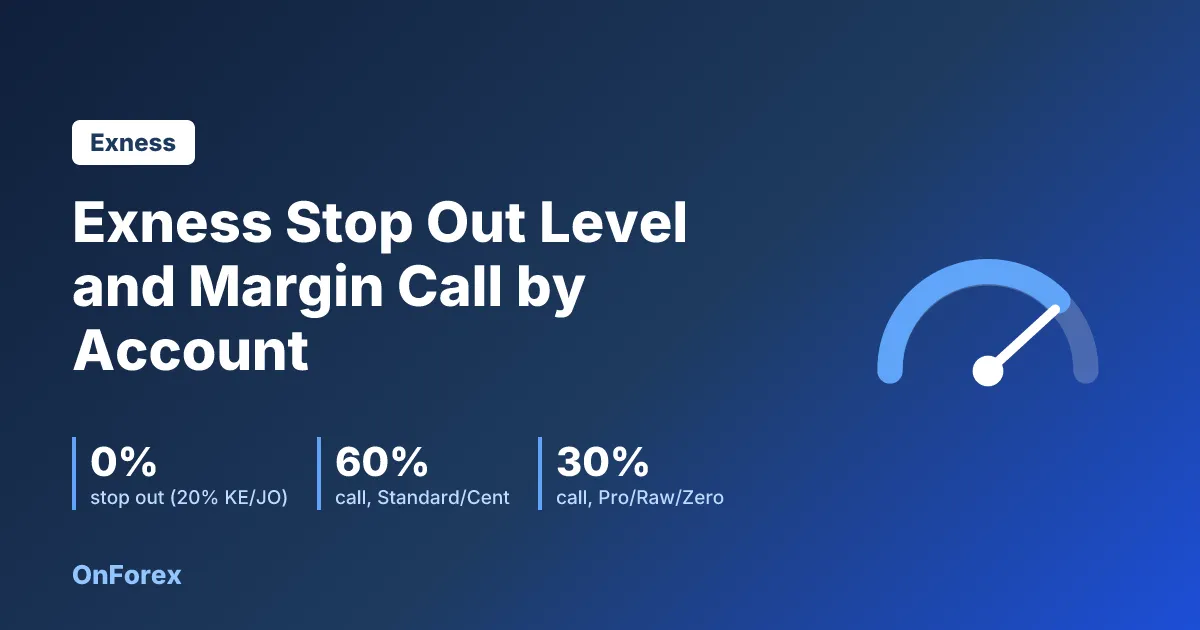
Exness Stop Out Level and Margin Call by Account (2026)
Exness stop out level is 0% on every account type, with margin call at 60% or 30%. Kenya and Jordan clients have a 20% stop out. Worked examples and how to avoid it.
Exness Margin Calculator: Formula, Lot and Pip Examples (2026)
How Exness calculates margin, with the formula and checked examples for EURUSD, gold and cent accounts. Plus lot size and pip value calculators, and where to find the tool.