AI Trading Bots and AI EAs: Red Flags and How to Check Them
Are AI trading bots real? Learn what an AI EA actually is, the scam red flags to watch for, and a checklist for testing any bot, with our own overfitting data.
This site contains affiliate links. We may earn a commission if you sign up through our links. How we research
An AI trading bot is an automated program that places forex trades for you, and the "AI" in its name tells you very little: most are ordinary rule-based Expert Advisors (EAs), a few use machine learning, and some do not trade at all. Before you trust any bot, check for the scam red flags below, then test it with out-of-sample data, a long verified live record and a demo account. In our own overfitting test, the most flexible models scored 71% to 79% accuracy on the data they had memorised and about 52% on new data.
Disclosure: OnForex may earn a referral commission from Exness links on this page. This is general education, not investment advice.
This guide is for traders who have seen an advert for a robot that "trades with AI" and want to know whether it is worth their money. It does not review or rank any product, because the checks work on any of them. If you would like to see what our own machine learning test found about predicting price, read our guide to AI trading in forex.
What an "AI bot" or "AI EA" really is
An Expert Advisor (EA) is a program that runs inside a platform such as MetaTrader 4 or MetaTrader 5 and sends orders automatically. The code is usually written in MQL4 or MQL5, or in Python connected to a broker's interface. A bot is the everyday name for the same idea.
Three very different things are sold under the label "AI":
| What it is | How it works | What to ask |
|---|---|---|
| Rule-based EA with an AI label | Fixed conditions, such as "buy when RSI is below 30 and price is above the 200 EMA" | What are the exact rules? If the seller will not say, why? |
| Machine learning model | A statistical model trained on past data to output a prediction, which the EA then trades | What data, which inputs, how was it tested out of sample? |
| Chatbot or language model in the loop | A large language model reads text and suggests an action | Does it see live prices? What happens when it is wrong? |
There is nothing wrong with a rule-based EA. The problem is the label. Calling a moving average crossover "AI" can make an old idea sound new and safe. The rules can still be sound or unsound, and you should judge them the same way whether the product is called an EA, a robot or an AI.
If you want to see how a chatbot can help your own analysis without trading for you, our guide to using ChatGPT and other AI chatbots for trade analysis covers it.
How these products are usually sold
Most are sold in a few ways: a one-time download or monthly licence, a subscription to "signals" or a managed account, or a copy-trading style arrangement where the seller trades your money. The sales page tends to show a smooth equity curve, a high win rate and a testimonial. What it rarely shows is the thing that matters: an independent record you can check yourself.
Some of these offers are honest products that simply do not deliver. Others are built to take your deposit, your fees or your login. You cannot tell which from the sales page, so you need a method, not a feeling.
Red flags that should stop you
Treat each of these as a reason to pause. Two or more together are a strong warning.
- Guaranteed or fixed returns. "5% a week" or "no-loss system" cannot be true. Markets do not pay on a schedule, and no legitimate firm can promise a result.
- "AI" with no way to verify it. There is no explanation of the data, the method or the testing, only a claim that it is smarter than human traders.
- Screenshots instead of verified live accounts. Screenshots can be edited or taken from a demo account or one of many accounts, and only the best one is shown.
- Backtests only. A backtest is a replay of the past with rules that were often tuned on that same past. We show below how large the gap can be.
- Martingale or grid logic hidden inside. The curve is smooth and the win rate is high until one deep losing run wipes out months of gains. See what martingale does to an account.
- A request for your login, password or control of your account. Never share your trading password. If someone needs "access" to trade for you, understand exactly what they can do, including withdrawing.
- Recruitment rewards or a levels structure. If you earn more for bringing in other buyers than for the bot's trading, the product is the recruitment.
- Pressure to deposit more. Countdown timers, "last places" and demands to top up to "unlock" better results are sales tactics, not trading.
- Withdrawals blocked until you pay a fee or "tax". This is a common advance-fee pattern. Real brokers deduct charges from your balance and do not ask you to send more money first.
- Unrealistic claims about speed or secret data. "Our AI sees what banks see" cannot be checked and is not how retail platforms work.
Spreads widen around news and market opens, and stops can fill worse than planned. A bot that looks perfect in a backtest without these costs is showing you a cleaner world than the one you will trade.
How to check a bot honestly
A bot that passes the red-flag test is still unproven. The following steps give you evidence instead of promises.
1. Look for a third-party verified live record
You want a record on a real-money account that is hosted by an independent service, that you can open yourself, and that shows each trade with its time, size, entry, stop and result. Ask:
- Is the account live, not demo?
- Is it at least 12 months old?
- How many trades does it show? A hundred or more gives you something to measure.
- Is the account connected for the whole period, with no gaps in the history?
A single account is also not the whole story. If the seller runs ten accounts and shows one, the one is a survivor.
2. Read the maximum drawdown, not just the profit
Drawdown is the fall from a peak in your account value to the next low. A bot that "makes 8% a month" with a 60% drawdown is far riskier than the headline suggests, because a 60% loss needs a 150% gain to recover. See our drawdown guide for the recovery table.
3. Check the lot-size pattern
Open the trade history and watch the position sizes. If the lots rise after losses (for example 0.01, 0.02, 0.04, 0.08), or if the bot keeps adding trades in the same direction as price moves against it, you are looking at martingale or a grid. These systems have high win rates until they do not.
4. Compare backtest and live results
Ask for both on the same period and with the same settings. A large gap between them is a sign of overfitting, bad assumptions about costs, or both. Fit is easy to produce; our backtesting guide shows how to separate in-sample from out-of-sample results.
5. See how it behaves around news
Look at what the bot did during major releases and market opens. Did it avoid them, trade through them or take heavy losses from slippage? Our slippage guide and news trading guide explain why fills can move.
6. Demo first, then tiny live size
Run the bot on a demo account for at least a few weeks, and then on a small live account with money you can afford to lose entirely. Do not scale up because of a good month. A demo hides slippage and requotes, so a good demo is the start of the test, not the end.
7. Keep your own risk limits
Even a good bot can be wrong. Decide the maximum drawdown you will accept before switching it off, and size it using the same principles as manual trading. Our risk management guide and position sizing guide show how.
Our evidence: why curve-fitted results fade
We ran three tests that explain why the glossy results on a sales page often do not survive contact with new data.
The best setting of 39 lost nearly all its edge
We tested 39 settings of a simple EMA crossover on EURUSD 4H and picked the best one on the first 20 months. It made +758 pips net of costs on the data it was chosen from. On the following year it made +40 pips on 12 trades.
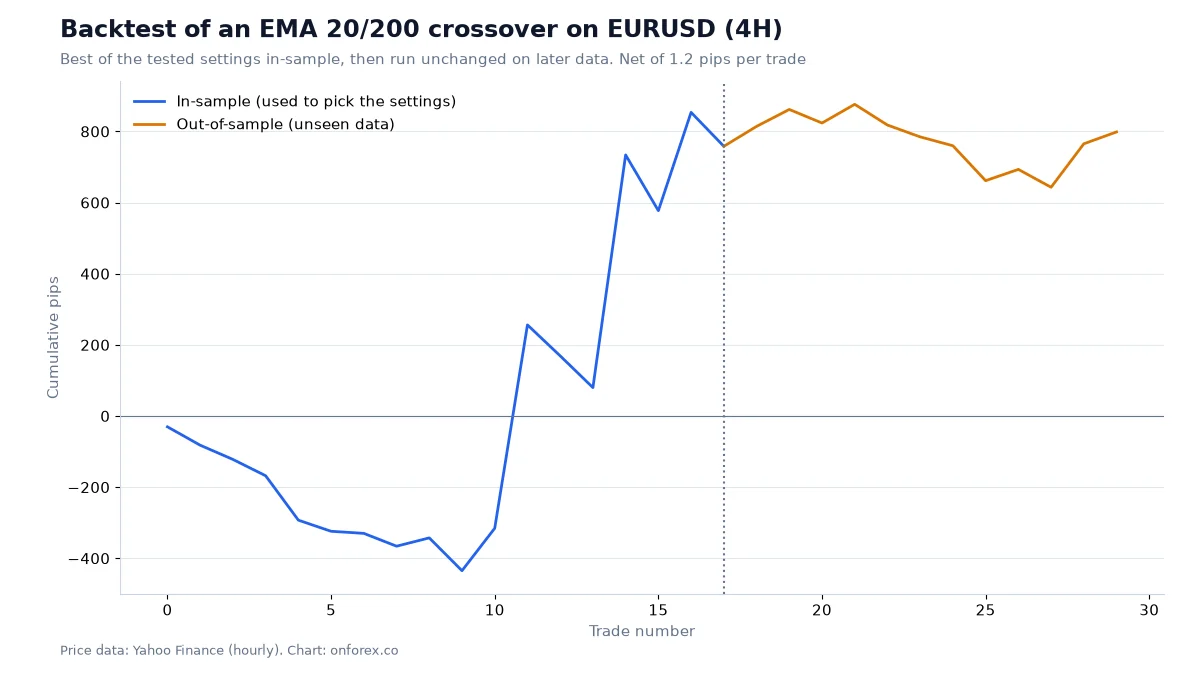
If someone shows you only the blue line, they are showing you the part that was chosen to look good.
Flexible models memorise the past
In our walk-forward machine learning test (a model trained only on data before each month, then tested on that month), we compared how accurately three models predicted the next 24 hours on the data they were trained on and on new data. Averaged over four markets, the logistic regression scored 54.8% on its training data and 52.6% on new data. The random forest scored 71.3% and then 52.5%. The gradient boosting model scored 79.1% and then 52.1%.
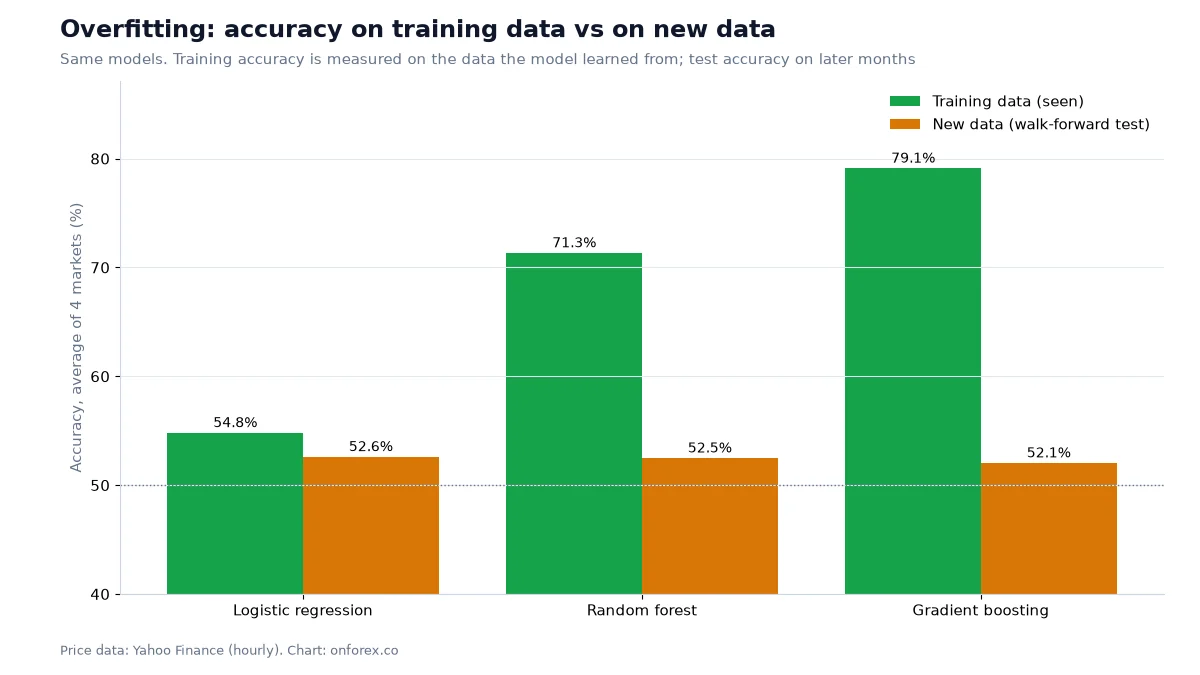
A backtest of a flexible model on the data it learned from can look spectacular. That is the number a seller can show you. The honest number is the right-hand bar. For the full test and its baselines, see our AI trading guide.
Martingale ruined most simulated accounts
In a simulation of 20,000 accounts, each making 200 coin-flip trades with no edge, doubling the stake after every loss ruined 62.8% of them. Multiplying by 1.5 ruined 15.4%. Risking a fixed 1% ruined none.
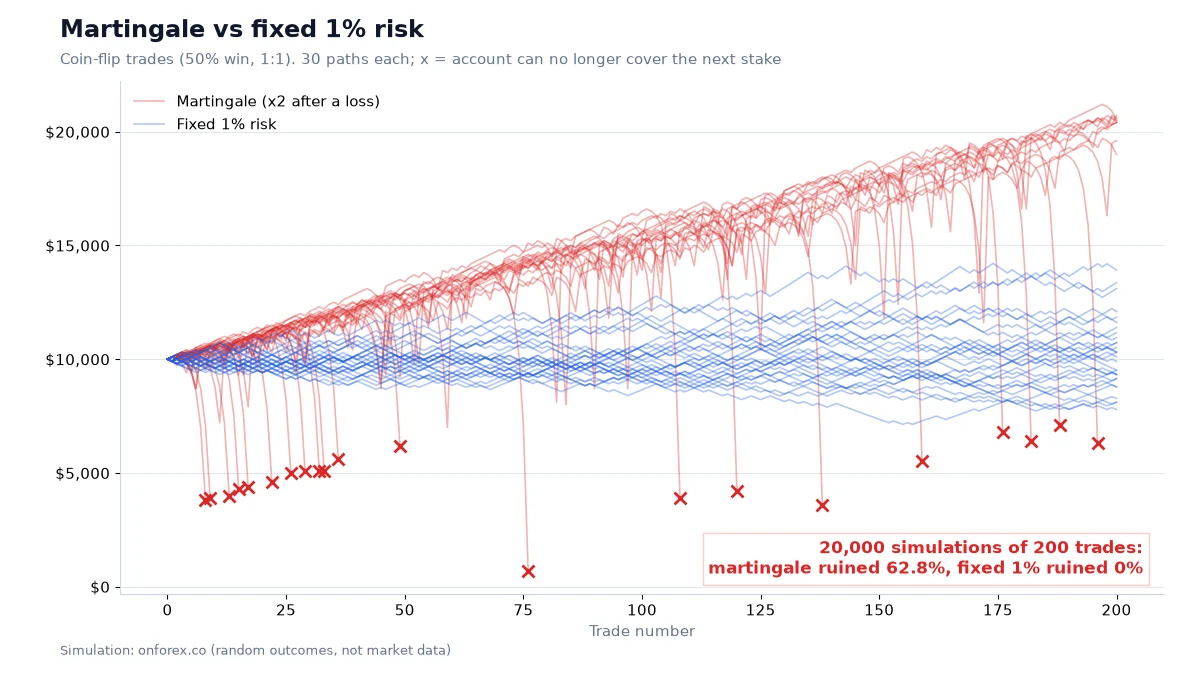
A martingale bot looks wonderful on a short backtest for exactly this reason. The long run is where the loss sits.
Common mistakes
- Trusting a short record. Three good months can be luck, as our risk per trade simulation shows even for methods with a real edge.
- Judging a bot by win rate. A 95% win rate with an occasional large loss can be worse than a 40% win rate with controlled stops.
- Buying signals instead of testing them. Our trading signals guide lists what to check before following anyone else's trades.
- Running a bot on your whole account. Use a separate small account so one failure cannot take everything.
- Switching bots after every losing month. That is how you end up chasing a different bot's best month each time.
- Ignoring your own psychology. If you cannot sit through the drawdown the bot will have, you will switch it off at the worst moment. See trading psychology.
If you think you have been scammed
- Stop sending money. Anyone who says you must pay a fee, tax or "unlock" payment to get your money back is repeating the scam.
- Keep records. Save chat messages, emails, receipts, wallet or bank details, website addresses and screenshots of your balance.
- Contact your bank or payment provider quickly and ask whether a payment can be disputed or stopped.
- Report it to the financial regulator and the police in your country, and to the platform where you were approached.
- Be wary of recovery offers. People who contact you offering to get your money back for an upfront fee are often the same scammers or their partners.
Our data
The overfitting and walk-forward figures come from the OnForex walk-forward test on hourly prices from Yahoo Finance, January 2024 - October 2026 (gold: June 2024 - October 2026, COMEX gold futures). The EMA example is OnForex analysis of EURUSD 4H data from the same source, net of 1.2 pips per trade. The martingale results come from an OnForex Monte Carlo simulation of 20,000 runs of 200 coin-flip trades, without spreads or slippage. These are tests of ideas on past or simulated data, not forecasts and not a verdict on any product.
Related guides
- AI trading in forex: our walk-forward machine learning test
- Using ChatGPT for trade analysis: practical uses and prompts
- Backtesting a trading strategy and martingale
- Risk management, drawdown and forex signals
Practise on a demo account first
Test any idea or tool on a free Exness demo account before you risk money. Forex and CFD trading carries a high risk of loss.
Continue to ExnessForex and CFD trading involves significant risk. You may lose your invested capital.
Risk warning: Forex and CFD trading carries a high risk of loss and may not be suitable for everyone. Automated systems can lose money quickly, and past or backtested results do not guarantee future results. This page is education, not investment advice.
Related Articles
Exness vs HFM 2026 — Full Broker Comparison for Global Traders
Exness vs HFM compared: which company serves you, spreads and commissions, account types, leverage, platforms, payments, and who each broker suits. Updated for 2026.
Exness in Europe: Restrictions, ESMA CFD Rules, Registers
Exness in Europe: Exness says its entities do not serve European residents. ESMA CFD leverage limits, how to check CySEC, BaFin and ESMA registers, scam warnings.
Is Exness Available in the USA? What US Residents Should Know
Is Exness available in the USA? Exness says it does not serve US residents. Why, how to check a forex broker on the CFTC and NFA BASIC, and scam warnings.
Exness Review 2026: Is It Legit? Complaints, Withdrawals, Fees
Exness review 2026: is Exness legit, what bad reviews and complaints on Trustpilot and forex rating sites usually cover, withdrawals, fees and your entity.

Forex Broker for Scalping and Scalping Bots: Execution, VPS and Costs (2026)
Which forex broker suits scalping and MetaTrader scalping bots? What to check: execution model, VPS near the trade server, stop levels, spread vs commission. Checked 2026-11-01.
Exness UK: Is It Available? FCA Register and CFD Rules
Exness UK explained: Exness says it does not serve UK residents. How to check a broker on the FCA Register, UK CFD leverage limits and scam warnings.