ICT Kill Zones: London, New York and Asia Times (UTC) With Data
ICT kill zones explained with times in UTC and New York time, how daylight saving shifts them, and our hourly range data for EURUSD, GBPUSD, USDJPY and gold.

This site contains affiliate links. We may earn a commission if you sign up through our links. How we research
ICT kill zones are the parts of the trading day when price is most active, mainly the London open and the New York open. In our hourly data, EURUSD moves about 15-19 pips per hour in those windows, against roughly 7-8 pips overnight. The times below are given in UTC and New York time, with the daylight-saving shifts spelled out, because that is where most mistakes come from.
Disclosure: OnForex may earn a referral commission from Exness links on this page. This is general education, not investment advice.
Kill zones are one part of the wider smart money concepts toolkit. They answer "when", where market structure, order blocks and fair value gaps answer "where". For the broader picture of sessions and market hours, see trading hours.
The kill zones and their times
ICT teaching defines the windows in New York time. The usual versions are:
| Kill zone | New York time | UTC in northern winter | UTC in northern summer |
|---|---|---|---|
| Asian | 20:00-00:00 | 01:00-05:00 | 00:00-04:00 |
| London | 02:00-05:00 | 07:00-10:00 | 06:00-09:00 |
| New York (morning) | 07:00-10:00 | 12:00-15:00 | 11:00-14:00 |
| London close | 10:00-12:00 | 15:00-17:00 | 14:00-16:00 |
Different teachers shift these by an hour or so, so treat them as approximate. The shaded zones on our own chart are fixed UTC hours: London 07:00-10:00 UTC and New York 12:00-15:00 UTC. We chose fixed UTC hours because our data is stored in UTC and it keeps the comparison simple, not because those are the "correct" kill zones.
What our hourly data shows
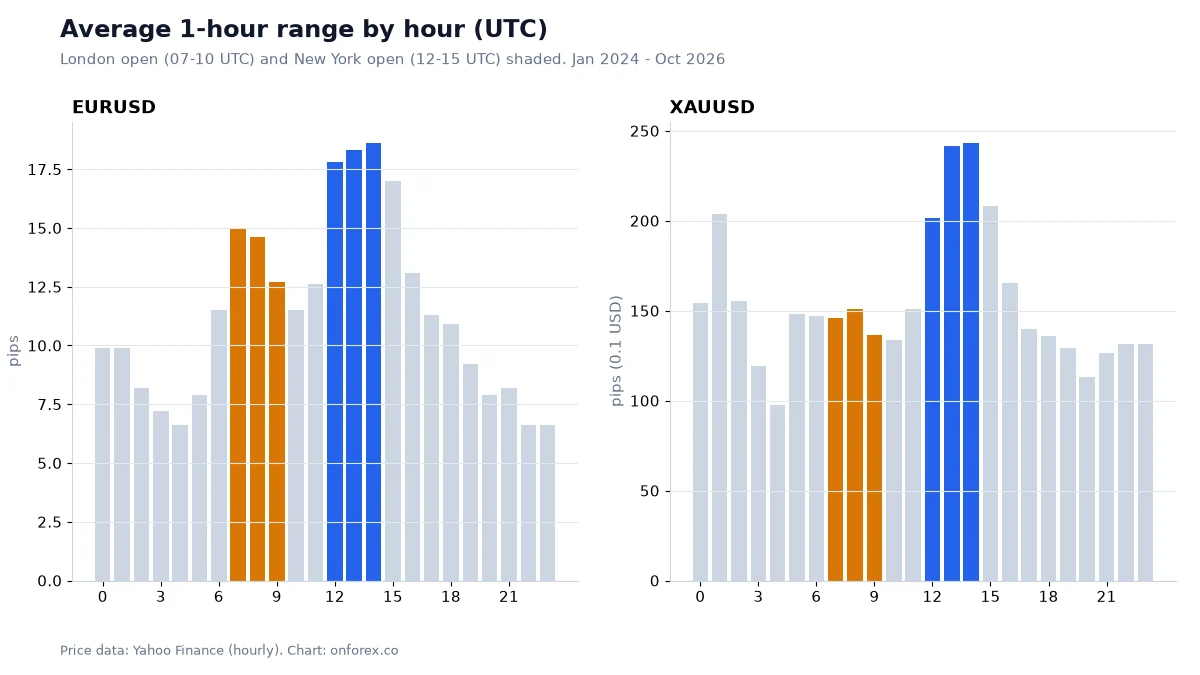
Source: OnForex analysis of hourly prices from Yahoo Finance, January 2024 - October 2026 (gold: June 2024 - October 2026, COMEX gold futures). The chart plots the average high-to-low range of each 1-hour candle by the UTC hour it opens.
What it shows:
- EURUSD is quietest from 22:00 to 04:00 UTC at roughly 6.6-8 pips per hour. It rises to about 15 pips around 07:00-08:00 UTC (London) and reaches its highest, around 17-18.6 pips, in 12:00-15:00 UTC (New York).
- GBPUSD peaks at 14:00 UTC with an average range of 22.9 pips.
- USDJPY peaks at 13:00 UTC at about 33.8 pips, with a second high at 00:00 UTC (31.4 pips), which is the Tokyo morning.
- XAUUSD (gold) peaks at 13:00-14:00 UTC at about USD 24 per hour, against roughly USD 10-13 in the late US and Asian hours.
So the "London" and "New York" windows are real in the sense that ranges are measurably larger. The New York window is the busiest for EURUSD, GBPUSD and gold. Yen pairs are active in Tokyo hours too. This also explains why the Asian session is often described as a quiet range that the London session later breaks out of: EURUSD moves about half as much per hour overnight.
Why daylight saving matters
New York and London switch clocks on different dates. In the US, summer time runs from the second Sunday of March to the first Sunday of November. In the UK it runs from the last Sunday of March to the last Sunday of October. UTC does not change.
Two consequences:
- A window fixed in local time moves by one hour in UTC. The New York open at 08:00 local time is 13:00 UTC in winter and 12:00 UTC in summer. If you use a fixed UTC chart, your "kill zone" will drift against the real open twice a year.
- The gap between sessions changes for a few weeks. In 2026 the UK moved back on 25 October and the US moves back on 1 November, so for that one week the London and New York opens are one hour closer together than usual.
Our averages mix both summer and winter data, because they are grouped by UTC hour. This blurs the peaks slightly: a true New York open effect lands on 12:00 UTC in summer and 13:00 UTC in winter, and both fall inside our shaded window. Always check which time zone your platform's chart uses; many brokers show server time, which is not UTC.
How traders use kill zones
Treat these as scheduling, not signals:
- Plan before the window. Mark the higher-timeframe structure, the dealing range and the liquidity above and below the Asian range.
- Watch the first move. A common ICT idea is that the London session often sweeps one side of the Asian range first. This is a description of what traders look for, not a rule. Our measurements of how often London takes the Asian range are on the Power of Three page, and the measured reversal rate after a sweep (near 50-55%) is on the liquidity sweep page.
- Use the same rules in every window. If your structure, stop and target rules do not change by session, you can review trades by session later and see whether the time of day matters for you.
- Know when to stop. Ranges shrink late in the New York afternoon. Many traders simply stop after their window.
If you trade day trading or scalping styles, session timing matters more because holding periods are short. Gold behaves differently from currencies; see the gold trading guide.
Wider ranges cut both ways
Large hourly ranges are not a free advantage:
- Spreads widen at opens and around news such as US data releases, so the same stop can cost more to enter.
- Slippage is more likely when a stop order is triggered during a fast move; the fill can be worse than your stop price. See slippage.
- Stops need room. In our data a random entry with a 1 ATR stop was hit within 24 hours 73-78% of the time, and with a 0.5 ATR stop 86-88%. A narrow stop in an active window is hit more often, not less.
A wider typical range means your stop, sized in ATR terms, is also wider, which means a smaller position for the same risk. The position sizing guide shows the arithmetic.
Gold, yen pairs and the Asian session
Not every market follows the same clock. Our data shows USDJPY with a second busy period at 00:00 UTC (Tokyo morning, 09:00 in Japan), which is why yen traders often treat Asia as a real session rather than a lull. Gold's busiest hours, 13:00-14:00 UTC, line up with the US data releases and the New York open, when futures volume is highest. An average of about USD 24 per hour at that time, against USD 10-13 later in the day, means a gold position sized for the quiet hours can become far riskier when the US session opens.
For EURUSD and GBPUSD, the Asian session is better treated as context than as a trading window. The range it builds (the high and low between roughly 00:00 and 07:00 UTC) is a convenient reference for the liquidity that traders talk about: stops sit just beyond those extremes. Marking that range before London opens costs nothing, and you can decide afterwards whether it helped you.
A simple way to test kill zones on your own trades
Rather than accepting a claim about the best hours, check it against your own record. Keep a trade journal with the UTC hour of each entry and the result in R (profit or loss divided by the amount you risked). After 50-100 trades, group them by session: Asian, London, New York, other. Compare the average R and the number of trades in each group.
Be cautious with small samples. With 20 trades per session, a handful of lucky results can make one window look special. If the differences are small, the practical conclusion is that your setups do not depend on the clock, and you can pick the hours that fit your life. If one window clearly costs you money, simply avoid it.
It also helps to separate two questions. The first is whether price moves more at a given hour, which our data answers: yes, measurably. The second is whether you trade better at that hour, which only your journal can answer. A busy market rewards a good plan and punishes a sloppy one with equal speed, and the psychology of fast markets (rushed entries, moved stops) is a common reason results get worse, not better, in the most active hours.
Common mistakes
- Mixing time zones. Check whether your chart shows UTC, broker server time or your local time before marking a window.
- Ignoring daylight saving. A kill zone that was right in July can be an hour off in November.
- Trading every window. More hours mean more trades and more costs, not necessarily better trades.
- Assuming volatility equals direction. A big range tells you the market is moving, not which way.
- Forgetting the news calendar. A scheduled release can dominate a window; check the economic calendar first.
Practise on a demo account first
Mark structure, FVGs and stops on a free Exness demo account before you risk money. Forex and CFD trading carries a high risk of loss.
Continue to ExnessForex and CFD trading involves significant risk. You may lose your invested capital.
Risk warning: Forex and CFD trading carries a high risk of loss, and many retail accounts lose money. Statistics here describe past data under our definitions and do not predict future results. Nothing on this page is investment advice.
Related Articles

London Breakout Strategy: Asian Range Rules, Times and Data
London breakout strategy explained: how to mark the Asian range, entry, stop and target variants, false breakouts, UTC and JST times, and our data on four markets.

Forex Trading Hours: Market Sessions in Your Local Time (2026)
Forex trading hours in GMT and local time for New York, London, Tokyo, Sydney, Dubai, Lagos, Nairobi, Mumbai, Manila, Jakarta and Kuala Lumpur, plus DST notes.

ICT Silver Bullet: Times, Rules and What Our Data Shows
The ICT silver bullet strategy: the 10-11 am New York window, the sweep-and-FVG entry, time zone conversions, and our data on what that hour does.

Premium and Discount in ICT: Dealing Range and OTE
Premium and discount explained: how to mark a dealing range, find equilibrium at 50%, and use the OTE zone (62%, 70.5%, 79%) with a worked example.

Supply and Demand Zones: How to Draw, Trade and Test Them
Supply and demand zones explained: base and departure, how to draw a zone step by step, fresh vs tested zones, and how often zones held in our own 4H data.
ATR Indicator: Formula, Settings and ATR Stop-Loss in Forex
ATR explained: how Average True Range is calculated with a worked example, the 14-period setting, ATR stops, position sizing and our stop-hit data.