Trailing Stop Loss in Forex: Trailing, Break Even and Partial TP
How a trailing stop loss works in forex, plus break even stops and partial take profit, compared on the same EURUSD entries with our own test data.

This site contains affiliate links. We may earn a commission if you sign up through our links. How we research
A trailing stop (or trailing stop loss) is a stop that follows price at a set distance as a trade moves in your favour and never moves back. A break-even stop moves the stop to the entry price after a certain gain, and partial take profit closes part of the position early. All three are ways to exit, and in our test on the same EURUSD entries they changed the win rate and the size of winners far more than they changed the average result.
Disclosure: OnForex may earn a referral commission from Exness links on this page. This is general education, not investment advice.
How a trailing stop works
Suppose you sell EURUSD with a stop 1 ATR above the entry. ATR (average true range) is the average size of recent candles, usually over 14 periods; see our ATR indicator guide. As price falls, a trailing stop moves down with it. If you trail by 1.5 ATR, the stop always sits 1.5 ATR above the lowest close so far. When price rises back by that distance, the stop is hit and the trade closes.
Three rules define every trailing stop:
- What it follows: the best close, the best high/low, a swing point or a moving average.
- How far behind: a fixed number of pips, a multiple of ATR, or the distance to a structure level.
- It only moves one way: towards profit. A stop that moves back is not a trailing stop; it is a wider stop.
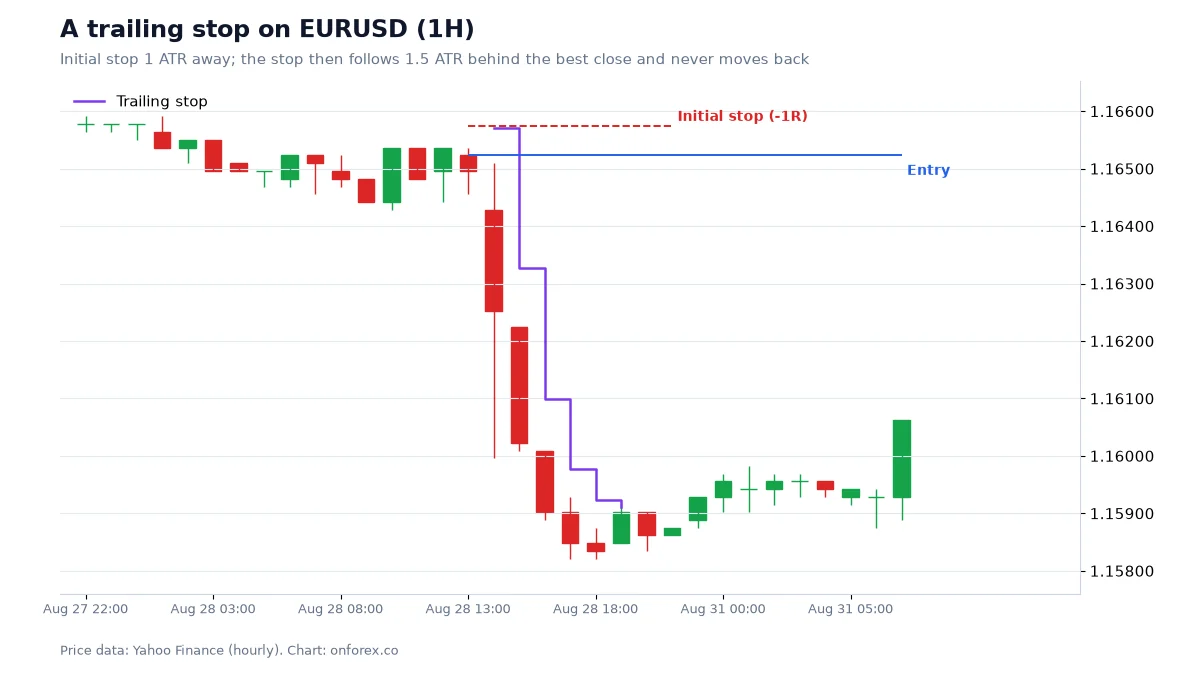
In the chart, the entry is near 1.1652 and the initial stop is just above 1.1657. Two large bearish candles pull the stop down in steps to about 1.1610, then to about 1.1598 and 1.1592. The low of the move is around 1.1582, and the stop is hit on the bounce. This is the trade-off in one picture: the trailing stop caught most of a fast move without a target, but it can never exit at the exact low.
Four ways to trail
| Method | Rule | Good for | Weak point |
|---|---|---|---|
| Fixed pips | Stop stays X pips behind price | Simple, quick to manage | Ignores volatility; too tight in active hours |
| ATR (chandelier) | Stop k x ATR from the best close or extreme | Adapts to current ranges | Can sit in the middle of nowhere on the chart |
| Swing-based | Below the last higher low (long) or above the last lower high (short) | Follows market structure | Moves rarely; gives back more in fast moves |
| Moving average | Exit on a close beyond, for example, the 20 EMA | Smooth trend following | Lags; whipsaws in ranges |
ATR or chandelier trailing stop
The chandelier exit hangs the stop a multiple of ATR from the highest high (long) or lowest low (short) since entry. Our test below uses a close-based version: 1.5 ATR behind the best close. The multiple matters. Our random-entry data shows that a stop of 1 ATR was hit within 24 hours in 73-78% of cases across four markets, and 1.5 ATR in 61-66% (see the stop loss guide). A trail tighter than about 1 ATR is mostly measuring noise.
Swing-based trailing stop
For a long trade, move the stop below each new higher low (HL) once it is confirmed; for a short, above each new lower high (LH). This ties the exit to market structure: you stay in while the trend's structure holds. Add a small buffer beyond the swing, because obvious swing points attract liquidity sweeps.
Moving-average trailing stop
Close the trade when a candle closes beyond a moving average such as the 20 EMA. It is easy to automate but reacts late. Our moving averages guide and pullback trading guide show how price interacts with the 20 and 50 EMA.
Break-even stops and partial take profit
A break-even stop (BE) moves the stop to the entry price once the trade is in profit, so the worst case becomes a scratch (about zero, minus costs). Partial take profit closes part of the position at a first target, usually with the rest protected by a BE stop. Both feel safe. The data shows what they cost.
Our data: same entries, four exits
To isolate the exit, we used deliberately simple entries and managed them four different ways.
- Entry: one trade per trading day at the open of the 13:00 UTC bar on EURUSD 1H, in the direction of the 1H EMA50 slope.
- Initial stop: 1 ATR(14). That distance is 1R, the risk unit (see risk-reward ratio).
- Maximum hold: 120 bars. Results in R, before spreads and swap.
Source: OnForex analysis of hourly prices from Yahoo Finance, January 2024 - October 2026.
| Exit | Win rate | Average R | Full -1R losses | Trades of 3R or more |
|---|---|---|---|---|
| Fixed 2R target | 32.0% | -0.04R | 68.0% | 0% |
| BE at +1R, target 2R | 26.3% | +0.01R | 51.9% | 0% |
| Trailing stop 1.5 ATR behind the best close, no target | 29.7% | +0.05R | 54.6% | 7.5% |
| Half off at +1R + BE, rest at 3R (partial take profit) | 48.1% | -0.02R | 51.9% | 0% |
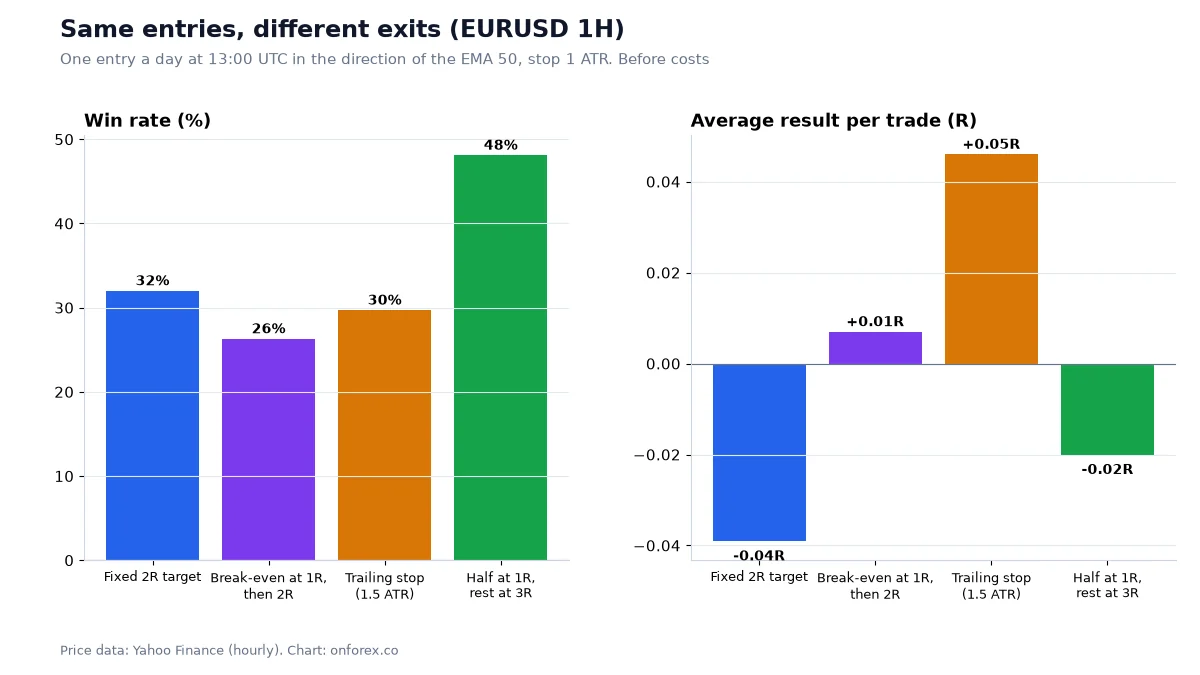
Other markets, average R for fixed / BE / trailing / partial:
| Market | Fixed 2R | BE at 1R | Trailing 1.5 ATR | Partial |
|---|---|---|---|---|
| EURUSD | -0.04 | +0.01 | +0.05 | -0.02 |
| GBPUSD | +0.04 | +0.07 | +0.19 | +0.02 |
| USDJPY | -0.05 | -0.02 | +0.03 | -0.02 |
| XAUUSD | +0.13 | +0.09 | +0.12 | +0.07 |
How to read these numbers
- No exit created an edge. The entries are simple and have no proven advantage, and all four exits on EURUSD ended within a few hundredths of an R from zero. If the entry has no edge, exit management alone will not create a reliable strategy. Costs would push these results lower.
- Break even swaps full losses for scratches. Full losses fell from 68.0% to 51.9%, but winners fell from 32.0% to 26.3%. The difference, about 22% of trades, ended near the entry price: trades that reached +1R, came back, and closed at zero. Some of them would have gone on to 2R.
- Partial take profit raises the win rate, not the profit. Banking half at +1R lifted the win rate to 48.1%, the highest of the four, because any trade that touched +1R now counts as a win. But the full-loss share is the same as BE (51.9%), and the best trades are capped. Average R was slightly negative.
- The trailing stop wins less often but catches runs. A 29.7% win rate with 7.5% of trades reaching 3R or more. On GBPUSD it had the best average (+0.19R), on gold it was close to the fixed target. Trend-following methods typically look like this: many small losses and a few large winners.
- Small samples, many tests. One entry per day over about three years gives several hundred trades per market. Differences of a few hundredths of an R are well inside what chance produces.
The practical point: choose the exit to fit the strategy and your temperament. If a long run of small losses makes you abandon a plan, a trailing stop will be hard to follow even if it suits trends. If seeing a +1R trade return to zero upsets you, partial take profit gives you a more even ride at the price of capped winners.
Worked example
Take a USD 1,000 account risking 1% (USD 10) on a EURUSD long with a 10-pip stop. The pip value per standard lot is about USD 10, so the size is 10 / (10 x 10) = 0.10 lots. See position sizing and pip value.
| Scenario | Fixed 2R | BE at +1R | Half at +1R, rest at 3R |
|---|---|---|---|
| Price goes straight to +3R | +USD 20 | +USD 20 | +USD 5 + USD 15 = +USD 20 |
| Price reaches +1R, then falls to the original stop | -USD 10 | USD 0 | +USD 5 + USD 0 = +USD 5 |
| Price falls to the stop first | -USD 10 | -USD 10 | -USD 10 |
With a 1.5 ATR trailing stop and no target, the first scenario could make more than USD 20 if the move continues, or less if the stop is hit on a pullback. The partial close also pays the spread twice (two closes) on smaller sizes; with 0.10 lots, half is 0.05 lots, and some accounts have minimum lot steps that make small partial closes awkward. Spreads widen around news and session opens, and a stop that is hit becomes a market order, so slippage can make any of these exits worse than planned. Our slippage guide covers this.
Setting a trailing stop in MetaTrader
In MT4 and MT5 you can right-click an open position and choose a trailing stop distance in points. Two details matter:
- It runs in your terminal. In MetaTrader the built-in trailing stop runs in your terminal, so it stops updating when the terminal is closed. The last stop level remains on the server and will still close the trade, but it no longer trails. Traders who need it to run continuously use a VPS or an Expert Advisor running on one.
- Points, not pips. On a 5-digit EURUSD quote, 150 points is 15 pips.
For differences between platforms, see MT4 vs MT5.
Common mistakes
- Trailing too tightly. A stop of less than about 1 ATR is hit by normal noise most of the time; you end up with many tiny exits.
- Moving to BE after a fixed number of pips. A BE move with no structural reason often turns future winners into scratches, as the 32.0% to 26.3% drop shows.
- Moving the stop away from price. That is widening risk, not trailing.
- Ignoring costs on partial closes. Each close pays the spread; on short-term trades this can remove the small edge you thought you had.
- Expecting the exit to fix the entry. In our test, no exit turned simple entries into a reliable positive result.
- Holding a trailing position over the weekend without accounting for gaps and, on multi-day trades, swap. See swap.
Related guides
Exits are part of a full trade plan: stop loss, risk per trade, drawdown and money management. Trailing stops are most common in trend trading and swing trading; test any exit on past charts first with our backtesting guide. Why traders move stops emotionally is covered in trading psychology.
Practise on a demo account first
Mark structure, FVGs and stops on a free Exness demo account before you risk money. Forex and CFD trading carries a high risk of loss.
Continue to ExnessForex and CFD trading involves significant risk. You may lose your invested capital.
Risk warning: Forex and CFD trading carries a high risk of loss and is not suitable for everyone. Stops, trailing stops and break-even stops do not guarantee an exit price and can fill worse than planned. Past test results do not predict future results. Never risk money you cannot afford to lose.
Related Articles

Stop Loss in Forex: Where to Place It (ATR, Structure, Pips)
Where to place a forex stop loss: structure-based, ATR-based and fixed-pip stops compared, how stop distance sets lot size, slippage, gaps, trailing and BE.

Forex Order Types: Market, Limit, Stop and OCO Explained
Forex order types explained: market, buy limit, sell limit, buy stop, sell stop, stop loss, take profit, trailing stop, OCO and slippage, with a EURUSD example.
ATR Indicator: Formula, Settings and ATR Stop-Loss in Forex
ATR explained: how Average True Range is calculated with a worked example, the 14-period setting, ATR stops, position sizing and our stop-hit data.

Forex Risk Management: How to Calculate Risk per Trade
Forex risk management step by step: calculate lot size from a 1% risk and a stop-loss, with USD 1,000 and USD 2,000 EUR/USD examples, drawdown and analytics.

Parabolic SAR: Settings, Formula and Backtest Results
Parabolic SAR explained: the formula, 0.02 / 0.2 settings, how to read the dots, why it whipsaws, and what a flip-every-signal test showed on four markets.
Risk Reward Ratio in Forex: R Multiples, Win Rate and Expectancy
Risk reward ratio explained with R multiples, the break-even win rate table, an expectancy formula with worked examples, and why a higher ratio is not always better.